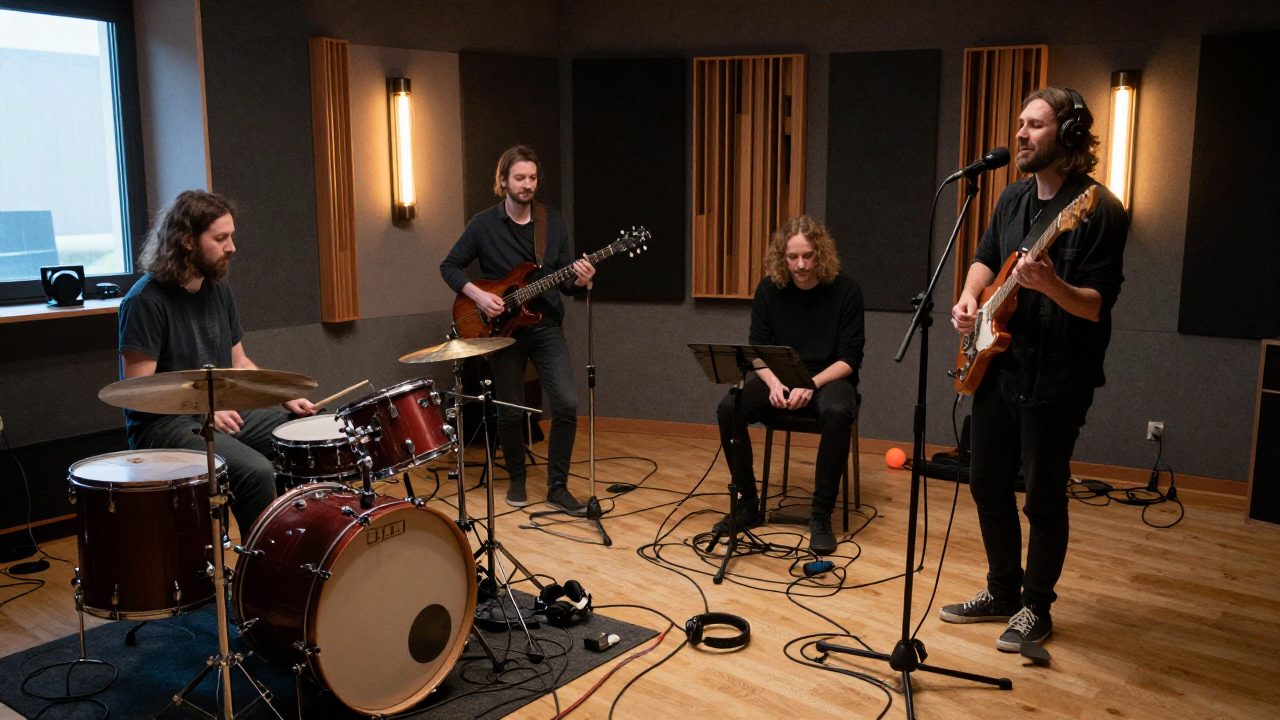
Playing together without getting in each other's way
The challenge of a live take is to let musicians play together while keeping enough separation between microphones to mix afterwards. We place the drums against the most treated wall, amps facing mobile acoustic screens, and acoustic instruments at a sensible distance. Everyone keeps eye contact with the others.
Guitar and bass amps can also be set up in the vocal booth, connected by cable, if the band wants to play louder or push the amp sound hard. Bass can be taken direct and from the amp at the same time, leaving the choice to the mix.
Headphone mixes for everyone
Each musician has their own headphone mix, adjustable from the control room: the drummer wants to hear the bass and the click, the singer mostly her voice and the guitars, the keyboard player a bit of everything. This detail changes everything: a musician who hears well plays more in tune and tires less.
We work with or without a click, depending on your habits and style. A click makes editing and overdubs easier; no click keeps a natural breathing. We can also prepare a guide track for songs that change tempo.
Recording the drums
The drums often define a band's sound. We use a classic combination: close microphones on kick, snare and toms, a pair of overheads, and room microphones. The live room adds a controlled natural ambience that can stay discreet or be pushed in the mix for a bigger sound.
We check tuning and resonances with the drummer before recording. A tired head or an overly ringing tom costs more time in the mix than a head change before the session; if necessary, we discuss it when quoting.
Planning the day
An eight-hour day usually allows you to record the basic tracks of four to six well-rehearsed songs, or two to three complete songs with vocals and overdubs. A half day suits one or two songs, a live session filmed by your own crew, or a demo. We take a lunch break in the middle of the day and short breaks between songs.
The secret of a good day is preparation beforehand. Songs should be well rehearsed, structures fixed and tempos known. Our article on rehearsing before the studio gives a simple method for arriving ready, and we can talk it through by phone before the session.
Formats, files and next steps
We record multitrack at 24-bit, 48 kHz by default. At the end of the day you receive a rough mix to review the takes, and the separate tracks are exported for mixing. If we mix, the session stays ready; if someone else mixes, we deliver named, aligned and consolidated tracks.
The session is kept for 6 months after the last session. Once the service is paid, the producer's rights in the recordings are yours: you are free to exploit them and have them mixed and mastered wherever you like.
Filming your session
Many bands want a video record of their day. You can come with your videographer or your own cameras; let us know so we can plan space and lighting. If people outside the band appear on screen, it is up to you to obtain their consent. The studio team only appears on camera with its agreement.
Who can book
The live room holds up to 6 musicians at once. For larger groups, choirs or ensembles, contact us: we can organise the session in several groups. Musicians under 18 are welcome from the age of 14 with written consent from their legal guardian, and with an adult present until the age of 16.
What is included
- Sound engineer for the whole session
- Studio drums, amps and piano
- Individual headphone mixes
- Acoustic screens and placement
- Rough mix at the end of the day
- Session backup for 6 months