Choosing the songs
Be realistic about the number of songs. For an eight-hour day, four to six well-rehearsed songs are a good target for basic tracks, or two or three if you also want to finish vocals and overdubs. Rank your songs by priority: if the day runs late, you will know which ones to drop.
Start the day with a song you play easily. It lets us set sounds and headphone mixes without pressure, and it builds the band's confidence. Keep the most demanding song for the middle of the day, when everyone is warmed up but not yet tired.
Locking the structures
Before the studio, every song must have a fixed structure: how many bars of intro, how many choruses, where the bridge falls, how the song ends. Write it on a sheet, simply: "intro 8 – verse 16 – chorus 8 – verse 16 – chorus 8 – bridge 8 – chorus x2 – end". Give a copy to each musician and one to the engineer.
Song endings are often neglected in rehearsal. Decide whether you end on a held chord, a hard stop or a fade: a fade is done in the mix, a hard stop has to be rehearsed.
Tempos and click
Note the tempo of each song in beats per minute. Record a rehearsal on your phone and check whether you speed up in the choruses or slow down in the verses: a little movement is natural, a lot makes editing and overdubs harder.
If you plan to play to a click in the studio, rehearse to a click beforehand. The drummer must be comfortable with it, otherwise they will spend the day following it instead of playing. Playing without a click is just as valid: simply decide in advance and tell us.
Preparing the instruments
Change guitar and bass strings two or three days before, not the night before: they need time to settle. Have instruments that buzz or won't stay in tune set up. For drums, heads in good condition save a lot of time; a snare that rings badly is hard to fix in the mix.
Bring spare cables, batteries for pedals, picks, sticks and a tuner. Take photos of your amp and effects settings: you can recall them for overdubs or a second session.
The stage plot
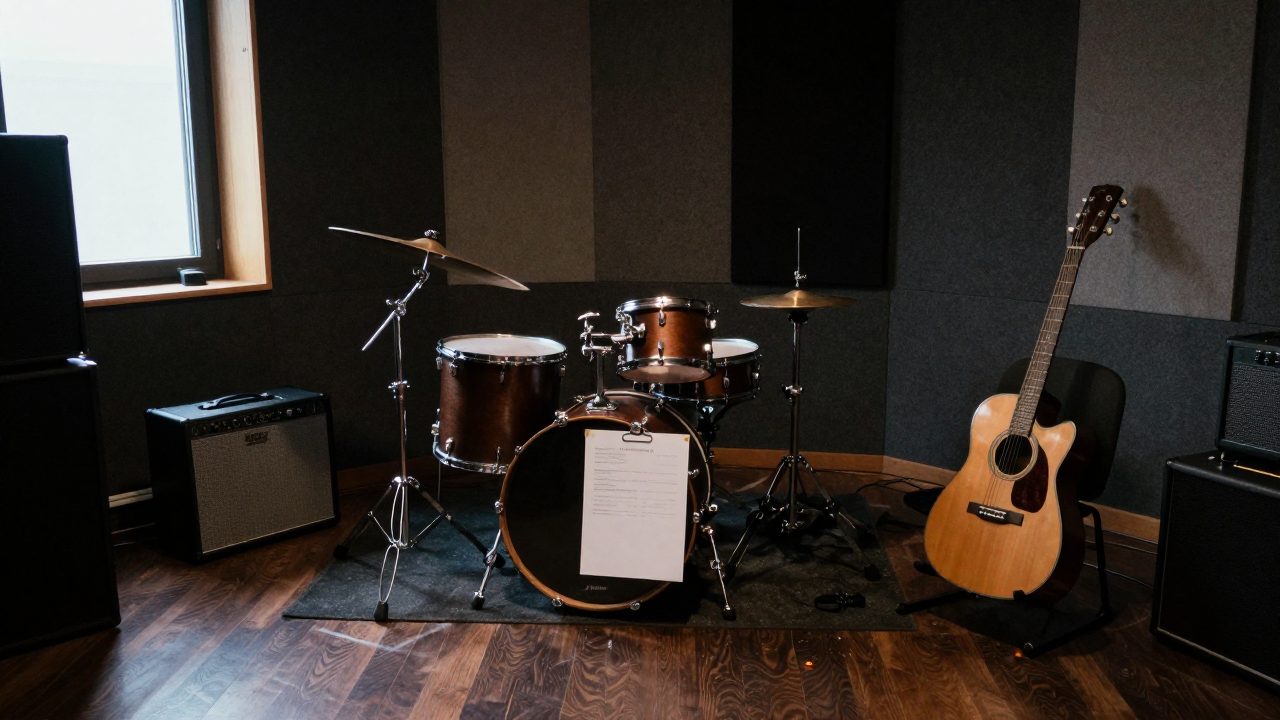
Send us a simple stage plot in advance: who plays what, how many amps, keyboard in stereo or mono, who sings, how many vocals. With this information we prepare the patch and placement before you arrive, and setup takes one hour instead of two.
Also tell us what each person needs to hear. Every musician will have their own headphone mix, but knowing the needs in advance speeds up the settings considerably.
During the day
Appoint one person to make decisions. In a band everyone has an opinion on the best take; without a clear decision, a lot of time is lost listening back. That person works with the engineer to approve takes and manage the schedule.
Take short, regular breaks, eat properly at lunchtime, and avoid listening back to every take in full. The engineer notes good takes as you go; trust them and keep your energy for playing.
The packing list
- Written structures for every song, in several copies.
- Tempos noted and, if needed, rehearsed to a click.
- Strings and heads changed a few days before.
- Spare cables, batteries, picks, sticks and a tuner.
- Stage plot sent to the studio.
- One or two listening references per song.
A prepared band often records twice as many songs as a band discovering its arrangements in the studio, for the same day rate.